


Electric Scooter Accessories
What is Motor Controller For Scooter
The controller or electronic speed controller (ESC) is an electronic circuit that controls the speed of the motor in an electric scooter. It receives input from the throttle and precisely controls the flow of current from the battery to the motor. For most scooters, the controller also provides regenerative braking capabilities. Controllers are rated in terms of current (measured in amps) and voltage (measured in volts), with higher-current, higher-voltage controllers being capable of driving more powerful scooters.
-
![Motor Controller For E Vehicle]() Motor Controller For E Vehicle48V 60V electric motorcycle brushlessmotor controller for e vehicleread more
Motor Controller For E Vehicle48V 60V electric motorcycle brushlessmotor controller for e vehicleread more -
![Motor Controller For Vehicle]() Motor Controller For Vehicle24V~72V electric bicycle /scooter DC Motor Controller brushless intelligentmotor controller for vehicleread more
Motor Controller For Vehicle24V~72V electric bicycle /scooter DC Motor Controller brushless intelligentmotor controller for vehicleread more -
![Motor Controller For E Rickshaw]() Motor Controller For E RickshawElectric Bike Motor Controller 60v 250w Brushless DCmotor controller for e rickshawread more
Motor Controller For E RickshawElectric Bike Motor Controller 60v 250w Brushless DCmotor controller for e rickshawread more -
![Motor Controller For Rickshaw]() Motor Controller For Rickshaw48V 800W Electric vehicle scooter Brushless DCmotor controller for rickshawread more
Motor Controller For Rickshaw48V 800W Electric vehicle scooter Brushless DCmotor controller for rickshawread more -
![Motor Controller For E Tricycle]() Motor Controller For E TricycleThe best electric bike controller 60v 1000W motor controller for e tricycle dc motor controllerread more
Motor Controller For E TricycleThe best electric bike controller 60v 1000W motor controller for e tricycle dc motor controllerread more -
![Motor Controller For Tricycle]() Motor Controller For Tricyclebrushless controller, motor controller for tricycle / E-bike / E-scooter / electric bicycle speed controllerread more
Motor Controller For Tricyclebrushless controller, motor controller for tricycle / E-bike / E-scooter / electric bicycle speed controllerread more -
![Motor Controller For E Scooter]() Motor Controller For E ScooterElectric Scooter 48V 1000W Brushless motor controller for E scooterread more
Motor Controller For E ScooterElectric Scooter 48V 1000W Brushless motor controller for E scooterread more -
![High Speed Bldc Motor]() High Speed Bldc MotorBLDC motors are very efficient for electric vehicle applications. The requirement of a permanent magnet in a BLDC motor is of concern as availability of the magnet is very uncertain. As a result,...read more
High Speed Bldc MotorBLDC motors are very efficient for electric vehicle applications. The requirement of a permanent magnet in a BLDC motor is of concern as availability of the magnet is very uncertain. As a result,...read more -
![Motor Controller For Scooter]() Motor Controller For Scooter45v Motorcycle Brushless Bldc motor controller for scooter 24Mosread more
Motor Controller For Scooter45v Motorcycle Brushless Bldc motor controller for scooter 24Mosread more -
![E Motor Controller]()
-
![Electric Motor Controller]() Electric Motor Controllerelectric motor controller 80V BLDC electric tricycles dc motor controllerread more
Electric Motor Controllerelectric motor controller 80V BLDC electric tricycles dc motor controllerread more -
![Universal Scooter Controller]() Universal Scooter Controlleruniversal scooter controllerhubMotor Controller made in CHINAread more
Universal Scooter Controlleruniversal scooter controllerhubMotor Controller made in CHINAread more


Advantages of Motor Controller For Scooter
Extended Lifespan: The absence of brushes in motors eliminates one of the primary sources of wear and tear in conventional DC motors. As a result, motors and their controllers have a longer lifespan and require less maintenance. This reliability is especially valuable in applications where downtime is costly, such as in manufacturing processes.
Higher Power Density: Motors can deliver higher power densities than their brushed counterparts. This means they can generate more power for a given size and weight. As a result, motor controllers are favored in applications where space and weight constraints are critical, such as aerospace and automotive systems.
Regenerative Braking: Motor controllers can implement regenerative braking, which converts kinetic energy back into electrical energy when the motor is decelerating. This energy can be stored or fed back into the power supply, further enhancing energy efficiency and reducing operating costs in electric vehicles and other applications.
Improved Thermal Management: Motor controllers can better manage heat generated during operation. Field-oriented control allows for more precise control over the motor's power output, reducing heat generation. Additionally, the elimination of brushes reduces friction, which can also contribute to lower operating temperatures.
Variable Speed Operation: Motor controllers excel in applications requiring variable speed operation. Whether it's a fan adjusting its speed based on temperature or an electric vehicle smoothly accelerating from a standstill, motor controllers provide precise control over a wide range of speeds.
How is Controller Power Measured
Voltage (V)
Voltage, commonly referred to as electric pressure, is a key measurement of how powerful a controller is. Measured in volts, it tells you the intensity at which the electricity is being pushed through a circuit.
Typically, electric scooter controllers fall into one of these six categories: 36V, 48V, 52V, 60V, 72V, and 84V.
A higher voltage equates to more power, and this results in greater torque, faster acceleration, and higher top speeds.
For example, a high-performance scooter with a large 60V 30Ah battery and powerful 60V 1000W motors will have controllers with a high voltage (60V) to match the rest of the scooter.
Current (A)
Measured in amps, current is the rate at which electricity flows through a circuit. Like voltage, it’s a useful indicator of how powerful a controller is.
Commonly, electric scooter controllers have an amperage that falls in one of these five buckets: 10A, 25A, 30A, 40A, and 50A.
The higher the current, the faster the controller can respond to signals and inputs from a scooter’s electrical parts. The most noticeable impact of this is greater torque, faster acceleration, and higher top speeds.
For example, a high-performance scooter with a large 60V 30Ah battery and powerful 60V 1000W motors will have controllers with a high voltage (60V), but also a high amperage (40A).
Where Are Electric Scooter Controllers Fitted


Deck
Most scooter controllers are kept in or under the deck, particularly if the battery is also stored here.
There’s plenty of space in the deck, so there’s no need to build any additional housing or widen any parts of the frame. However, because the inside of the deck is enclosed, temperature control can be an issue. To combat this, some manufacturers couple the controllers to the underside of the deck so that they can be cooled by the air flowing over them.
Stem
Scooters with the battery stored in the stem sometimes keep the controllers there too. This is because the stem will likely have been made wider to keep the battery, so there’s also plenty of space for the controller.
Any components stored here are well protected, but a scooter with a thicker stem can be harder to carry when in its folded position. Not only do these create more space in the deck to allow for bigger batteries, but they take advantage of natural air cooling, too.
Kickplate
If the scooter has a relatively small deck or a large battery, the manufacturers may build the controller into the kickplate.
In this position, it’s easy to access if it needs to be replaced, and it’s still relatively close to the battery, reducing the need for long connecting wires.
The electricity passing through a controller can cause it to get hot. Most manufacturers take steps to ensure that it won’t overheat. These include:
Heat Sinks
Heat sinks are systems that draw the heat away from mechanical components by transferring it into a liquid coolant or air.
Some scooters position heat-sensitive controllers at the front or underside of the deck so that cool air can flow over them and allow heat to dissipate.
Others use designs that surround the controllers with heat sinks to draw the heat away.
However, not all scooters are made equal and some have their controllers stored deep inside the deck where it’s almost impossible to cool them down.
Intelligent Temperature Controls
The vast majority of good-quality controllers use sensors to monitor and self-regulate their temperature.
If it exceeds safe levels, they lower power output to reduce heat and prevent damage. Once cooled, the power output will increase.
As previously mentioned, some advanced controllers even let you set the temperature at which they switch to a lower power mode.
Power Management
When you press on your scooter’s throttle, it activates a magnetic field within the motor. The voltage of the magnetic field is detected by a sensor that communicates this to the controller. This input is then used to send the correct voltage to the motor, thereby allowing it to rotate at the rate that the throttle requires.
No matter how hard you press on the throttle, the voltage of the magnetic field will be matched by the controller. For instance, if your scooter is equipped with a 60V controller and you push the throttle slightly, then it may only output 20V, resulting in a slow and steady speed. However, if you apply full pressure to the throttle, the controller will output its maximum power of 60V, resulting in faster acceleration and higher speeds.
When the brakes are applied, it’s the controller that stops the flow of electricity between the battery and the motors.
This overrides all other signals and prevents the motors and brakes from becoming damaged by working against each other.
When electronic brakes are applied, the controller sends a current to an electromagnet inside the motor hub. This creates a magnetic field that exerts a magnetic pull on the spinning central spindle to slow the rotation of the wheel.
Similarly, if you’re scooter has a regenerative braking system, the controller changes the flow of electricity from the motor back into the battery. This means that the motor is no longer powering the wheels, but charging the battery instead.
Because the scooter is still moving forward while braking, kinetic energy is created which keeps the motor turning. This creates electricity which is then directed to the battery for storage. By drawing the kinetic energy from the motor in the form of electricity, drag is created and this slows the rotation of the wheels.
As for anti-lock braking systems, otherwise known as ABS, these also rely on controller input to work.
Anti-lock braking systems are designed to prevent wheel lock so that you can remain safe and in control at all times. They work by sensing when the wheels are about to lock and then rapidly reducing and increasing the braking pressure multiple times per second. This allows the wheels to keep moving as the scooter slows down, instead of locking up.
On each wheel is a speed sensor. These detect when the brakes lock and immediately signal this to the controllers. Once the controller receives the signal, it activates the ABS.
When the cruise control function of a scooter is activated, the controller uses speed sensors on each wheel to keep the scooter running at a constant speed. Once engaged, you can remove your thumb or finger from the throttle and let the controller do all the hard work for you.
Maintaining the Health of Componentsit
Over-Voltage Protection
Over-voltage protection is a feature that shuts down the power supply when the voltage exceeds a preset level.
Most power supplies use over-voltage protection to prevent damage to their electronic components. The impact of over-voltage can cause certain components to degrade and in some cases, cause malfunctions or fires.
The most notable function of a controller here is to constantly monitor the battery voltage so that it doesn’t over-charge.
Low-Voltage & Over-Discharge Protection
Low-voltage protection is a control that prevents battery packs from over-discharging.
When your electric scooter battery has low voltage (i.e. has a low charge), leaving it in that discharged state puts it at a higher risk of remaining entirely discharged. Under these circumstances, if your battery happens to get discharged beyond the standard cut-off point, then its performance will significantly reduce, as will its lifespan.
It’s therefore the controller's role to monitor the voltage of the battery and then disconnect it from the load if it senses that the voltage has dropped below a minimum limit.
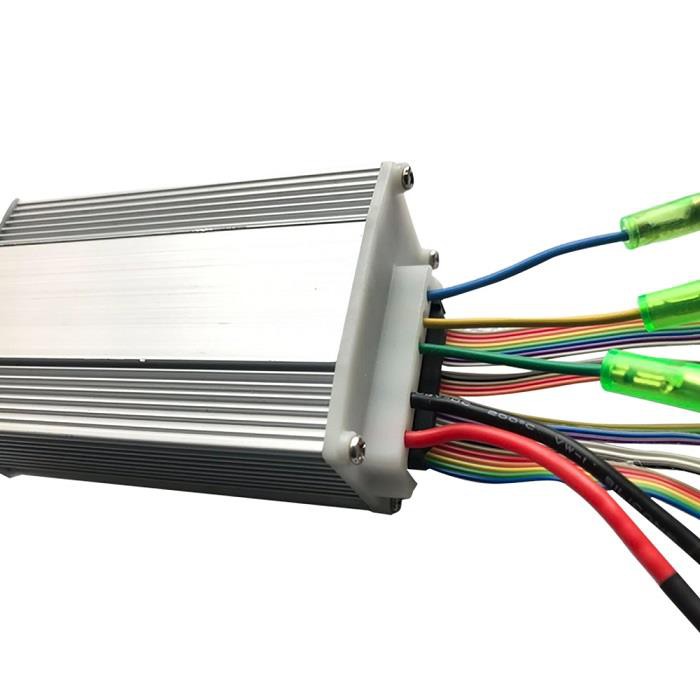

Over-Current Protection
Over-current protection, otherwise known as current limiting, is the process of limiting or entirely disabling current flow. It’s a safety mechanism that prevents currents that are higher than the acceptable rating of the circuit or equipment.
Uncontrolled over-current leads to excessive generation of heat, the risk of fire, and can damage equipment. It’s therefore very important to monitor and protect against this.
In electric scooters, controllers monitor the current that flows between the battery and the motors. If the current rises too high, the controller will limit it to prevent permanent damage.
Over-Temperature Protection
Over-temperature protection is a system that limits or shuts down the power supply when the internal temperature exceeds a safe value.
Here, controllers monitor the temperature of the transistors that regulate the flow of electricity within the motors. If they get too hot, the controllers will shut them down to prevent overheating.
Power Levels In Electric Scooter Motors
The power of adult electric scooters ranges from 80 to 12,000 watts. This range determines the maximum speed your scooter can reach. If you want a faster bike, you should choose a model with a high power level.
Most standard commuting electric scooters have a power of 200 to 500 watts. These models are best for people with a tight budget. The maximum speed for this type ranges from 25 km/h to 35 km/h. typically, half of the electric scooters today have this range.
However, heavy-duty scooters used mainly for performance and off-road driving have dual motors. These range from 1,200 to 3,000 watts. This range is for each motor in this scooter type and not a cumulative figure.
|
Power Level |
Maximum Speed |
|
250 Watts |
25 km/h or less |
|
350 Watts |
25 to 35 km/h |
|
500 Watts |
40 to 60 km/h |
|
1000 Watts |
50 km/h or more |
What is DC Motor
A direct current (DC) motor is a type of electric machine that converts electrical energy into mechanical energy. DC motors take electrical power through direct current, and convert this energy into mechanical rotation. DC motors use magnetic fields that occur from the electrical currents generated, which powers the movement of a rotor fixed within the output shaft. The output torque and speed depends upon both the electrical input and the design of the motor.
Advantages of DC Motor
Good Speed Control
DC motors offer highly controllable speed. By changing the armature or field voltage it’s possible to achieve wide speed variation and with this level of controllability, DC motors offer the precision required by a wide range of industry applications.
High Torque
A DC motor also offers a high starting torque, which makes it perfect for use in applications that are designed to move heavier loads, such as wiper systems and in industrial automation applications, such as conveyor systems or materials handling equipment. The consistent drive power that DC motors deliver means they’re ideal for maintaining a constant torque whilst an application is in use, making them an excellent choice for a geared motor solution.
Seamless Operation
As DC motors operate with high levels of controllable power across a range of speeds, they offer the benefit of seamless operation. In some industries, it is vital that DC motors can start and stop efficiently to cope with the requirements of the application. If you are looking for a solution that offers rapid acceleration, an option to reverse direction and start/stop efficiency, a DC motor is a good choice.
Free From Harmonics
In any electric power system, a harmonic is a voltage or current at a multiple of the fundamental frequency of the system, typically produced by the action of non-linear loads such as rectifiers or saturated magnetic devices. Harmonic frequencies in the power grid can be the cause of power quality problems and harmonics in some AC motors can cause torque pulsations, resulting in a decrease in torque. DC motors are free from issues associated with harmonics.
The DC motor is used to refer to any rotary electrical machine that converts direct current electrical energy into mechanical energy. DC motors can vary in size and power from small motors in toys and appliances to large mechanisms that power vehicles, pull elevators and hoists, and drive steel rolling mills.
DC motors include two key components: A stator and an armature. The stator is the stationary part of a motor, while the armature rotates. In a DC motor, the stator provides a rotating magnetic field that drives the armature to rotate.
A simple DC motor uses a stationary set of magnets in the stator, and a coil of wire with a current running through it to generate an electromagnetic field aligned with the centre of the coil. One or more windings of insulated wire are wrapped around the core of the motor to concentrate the magnetic field.
The windings of insulated wire are connected to a commutator (a rotary electrical switch), that applies an electrical current to the windings. The commutator allows each armature coil to be energised in turn, creating a steady rotating force (known as torque).
When the coils are turned on and off in sequence, a rotating magnetic field is created that interacts with the differing fields of the stationary magnets in the stator to create torque, which causes it to rotate. These key operating principles of DC motors allow them to convert the electrical energy from direct current into mechanical energy through the rotating movement, which can then be used for the propulsion of objects.
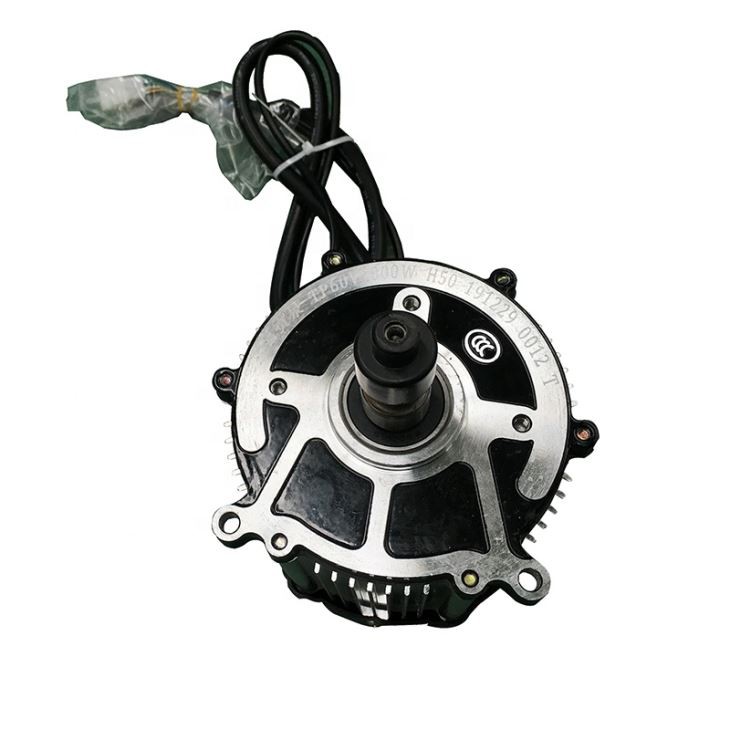
A DC motor is composed of the following main parts:
Armature or Rotor
The armature of a DC motor is a cylinder of magnetic laminations that are insulated from one another. The armature is perpendicular to the axis of the cylinder. The armature is a rotating part that rotates on its axis and is separated from the field coil by an air gap.
Field Coil or Stator
A DC motor field coil is a non-moving part on which winding is wound to produce a magnetic field. This electro-magnet has a cylindrical cavity between its poles.
Commutator and Brushes
The commutator of a DC motor is a cylindrical structure that is made of copper segments stacked together but insulated from each other using mica. The primary function of a commutator is to supply electrical current to the armature winding.
Brushes
The brushes of a DC motor are made with graphite and carbon structure. These brushes conduct electric current from the external circuit to the rotating commutator. Hence, we come to understand that the commutator and the brush unit are concerned with transmitting the power from the static electrical circuit to the mechanically rotating region or the rotor.

If length of conductor = L meter, field intensity = B weber per square meter (Bwb/m2) and current flowing in the conductor = i ampere, then the force experienced by the conductor will be F = iBL Newton.
F= B.L.I.Sinθ
where,
B = Flux density (in Tesla).
L = Length of conductor (in meters).
I = Current flowing in the conductor.
Sinθ = Angle between the conductor and magnetic lines of force.
AC and DC Motors
|
AC Motor vs DC Motor |
|
|
AC Motor |
DC Motor |
|
AC motor runs on alternating current. |
DC motors operate on direct current. |
|
There is no need for conversion of current in AC motors. Like AC. |
There is no need for conversion of current in AC motors. Like AC. |
|
AC motors are used where power performance is demanded for extended periods of time. |
DC motors are used where the speed of the motor needs to be controlled externally. |
|
AC motors can be single-phase or three-phase. |
All DC motors are single phase. |
|
In an AC motor the armature does not rotate while the magnetic field keeps rotating continuously. |
In a DC motor, the armature rotates while the magnetic field rotates. |
|
Repairing AC motors is not expensive. |
DC motors are very expensive to repair. |
Circuit of DC Motor Speed Control
Speed Sensor
Outputs a signal indicating the motor speed. Devices used for this purpose include Hall-effect sensors, encoders, and tachogenerators.
Speed Detection Circuit
Calculates the motor speed from the speed sensor signal.
Speed Reference
Outputs the target motor speed.
Comparator
Calculates the difference between the speed reference and measured speed.
Drive Voltage Calculation Circuit
Calculates the motor drive voltage based on the calculated speed error.
Drive Circuit
A circuit that adjusts the voltage applied to the motor in accordance with the drive voltage signal.
A DC motor can achieve steady operation by controlling its speed to remain constant regardless of changes in load. These motors are also suitable for a wide variety of control practices that can be implemented using a microcomputer. DC motors find uses in many different applications that take advantage of their ease of control.
Company Introduction
Jiaxing Eatrin Vehicle Co., Ltd.
We Eatrin Vehicle is a manufacturer that belongs to Eatrin Group, which has a long history in manufacturer electric vehicles and spare parts. Such as electric scooter, electric motorcycle, electric bike, electric rickshaw and electric car. Especially in electric bicycle sharing system solution including software and hardware.
Why Choose US
One-stop Solution
With rich experience and one-to-one service,we can help you choose products and answer technical questions.
Customization Services
They provide customization services to meet specific customer requirements, ensuring that clients receive products that exactly fit their needs.
Innovation
We are dedicated to improving our systems continually, ensuring that the technology we offer is always cutting edge.
24h Online Service
We try and respond to all concerns within 24 hours and our teams are always at your disposal in case of any emergencies.
FAQ
Find professional electric vehicle spare parts manufacturers and suppliers in China here. Please feel free to wholesale electric vehicle spare parts made in China here from our factory. All electric vehicles are with high quality and competitive price.
Scooter Controller 24v, Electric Scooter Woman, electric motorcycle for childen